


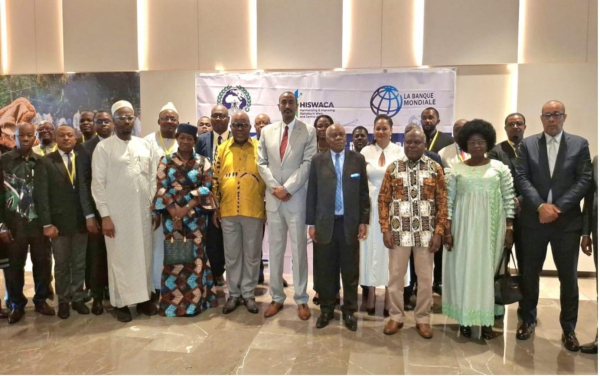
Libreville, Gabon – September 28, 2026 - The Economic and Monetary Community of Central Africa (CEMAC), in partnership with the African Energy Commission (AFREC), has advanced plans to establish a Regional Energy Information System (CEMAC-EIS), with Ministers responsible for Energy meeting in Libreville to strengthen energy data governance, mobilise resources and establish a common framework for collecting, validating, harmonising, and sharing energy information across its six member states.
The ministerial meeting held on Friday, 25 September, concluded a week of discussions involving CEMAC, AFREC, the World Bank, and other stakeholders which resulted in a roadmap defining the proposed system's governance arrangements. Some these included the role of national focal points, data channels, production schedules, validations, and data access, transmission, and dissemination initiatives.
The programme is being supported by the World Bank through the Statistics Harmonisation and Improvement Project for West and Central Africa (PHASAOC), with AFREC providing technical support to strengthen national and regional energy information systems.
CEMAC Commission President Mr. Baltasar Engonga Edjo'o said the proposed system would support regional policy coordination and economic convergence in addition to collecting statistics. “The role of this information system goes beyond the mere collection of data,” Mr. Engonga Edjo'o said, noting that common protocols for collecting, validating and disseminating information would help standardise energy indicators, enable objective comparisons among member states and strengthen evidence-based regional governance.
AFREC Executive Director Mr. Rashid Ali Abdallah called for a shared vision among CEMAC member states, stronger political commitment, and clear financing mechanisms. “The availability of reliable, harmonised, up-to-date and accessible energy data is today a strategic issue for Africa,” Mr. Abdallah said. “Reliable data enables governments to understand their energy systems, anticipate future needs, plan investments, monitor public policies and assess progress in energy access and the energy transition.”
Gabon’s Minister of Universal Access to Water and Energy, Mr. Philippe Tonangoye, stressed the importance of producing quality energy data in the implementation and monitoring of energy policies in Africa. “We need data that is reliable, data that is regular, that is regularly comparable, and that is sufficiently disaggregated,” Mr. Tonangoye said.
The ministerial meeting followed an experts' meeting held from 21 to 23 September, where technical representatives examined the proposed CEMAC-EIS architecture, assessed progress in the development of national energy information systems and identified institutional and technical challenges affecting energy data collection, harmonisation and validation.
Opening the experts' meeting, Mr. Léandre Emmanuel Bouloubou, Secretary General of Gabon's Ministry of Universal Access to Water and Energy, said a strong Energy Information System would support CEMAC's ambitions in electricity grid interconnection, regional energy infrastructure development, and establishment of a more integrated regional energy market.
Mr. Nicolas Beyeme Nguema, Commissioner in charge of Economic, Monetary and Financial Policy at the CEMAC Commission, said reliable and timely energy information was essential for both public authorities and investors. “Governments need accurate information to measure demand, forecast production requirements, monitor costs, assess subsidies, plan energy networks and track progress in energy access, while investors require consistent information to assess projects and associated risks.” He said.
The week-long discussions brought together representatives of CEMAC member states, AFREC, the CEMAC Commission and development partners to establish a common understanding of the CEMAC-EIS architecture and identify priority actions for implementation.
Through the initiative, CEMAC and its partners aim to strengthen the availability, quality and comparability of energy data, supporting evidence-based policymaking, investment planning and closer energy cooperation among the six member states.